

Table of Content
The LPU Online MBA in Data Science runs on 102 credits across 22 courses, spread over four semesters. Of these, 6 are core management courses, and 6 are discipline-specific electives that carry the program's data science focus, with the rest split between generic electives, ability enhancement courses, and the final project. The structure follows a deliberate order: general management first, technical specialisation later, and a capstone project at the end meant to pull both halves together.
The pedagogical logic is clear: students must master the fundamentals of business operations before advancing into technical specializations. This sequence ensures that every analytical model a student creates is grounded in commercial reality. By focusing on the 102-credit requirement, the program maintains a rigorous academic standard that balances technical depth with administrative breadth.
Building the Foundation: Management and Business Metrics
During the initial phase of the program, students focus on the essential metrics that drive corporate success. Key foundational courses include Financial Reporting, Statements and Analysis and Marketing Management. These modules provide the context necessary for high-level data analysis.
Understanding these business functions is critical for any data scientist. By mastering these subjects, students learn to identify the specific KPIs and financial indicators that matter most to stakeholders. This foundational knowledge ensures that future technical outputs remain relevant to executive needs and overall company health.
The Data Science Toolbox: Industry-Standard Technologies
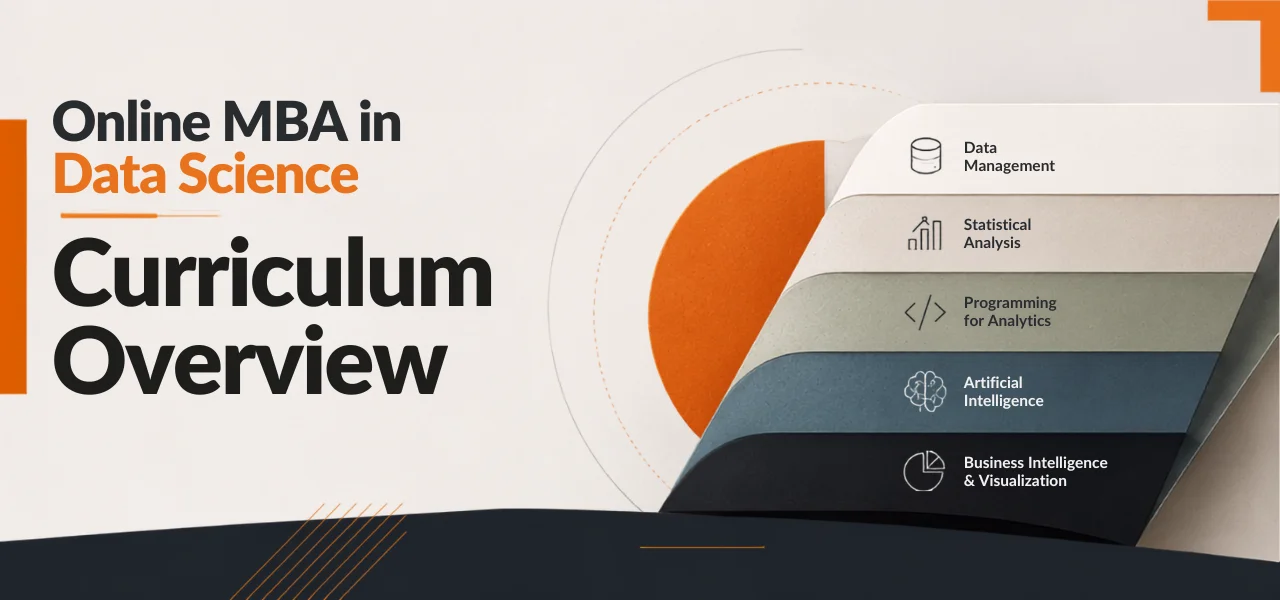
The curriculum prioritises hands-on proficiency with a modern suite of analytical tools. Students gain expertise in technologies that allow them to manipulate data and communicate findings effectively to leadership:
-
Tableau and Power BI: These platforms are used to create interactive visualisations that transform complex datasets into executive-ready narratives.
-
Python: This serves as the primary programming language for data manipulation, analytics, and building automated scripts for business efficiency.
-
Machine Learning Tools: Students focus on constructing predictive models to forecast market trends, operational bottlenecks, and customer behaviour.
-
Big Data Technologies: The syllabus includes specialized training for managing and analysing massive datasets that exceed the limits of traditional software.
Advanced Specialization: Semesters 3 and 4 Breakdown
The final year of the program offers heavy technical specialization, building student expertise through a series of incremental modules.
Semester 3 Analysis
Semester 3 establishes the mathematical and strategic bedrock required for advanced analysis:
-
ECAP780 (Probability and Statistics): This course provides the mathematical foundation necessary for all subsequent analytical work.
-
ECAP781 (Data Science Toolbox): This module introduces the essential software and libraries used by industry professionals.
-
ECAP782 (Advanced Data Visualization): Students master the communication of data-driven insights to non-technical stakeholders.
-
EMGN571 (Corporate Strategy and Entrepreneurship): This course links technical data science directly to high-level organisational planning.
Semester 4 Analysis
Semester 4 focuses on integration and high-level predictive modelling:
-
ECAP521 (Fundamentals of Machine Learning): This is a deep dive into algorithms, using the statistical foundations from ECAP780 to build predictive capabilities.
-
ECAP518 (Data Analytics with Python): This module involves the advanced application of Python to solve specific, complex business problems.
-
EMGN803 (Big Data Analytics): Students learn techniques for processing and interpreting high-volume data streams.
-
EMGN696 (Capstone Project): A final integrative project where students apply their entire 102-credit skillset to a real-world business challenge.
Instructional Methodology and Learning Flexibility
The program maintains a strict "management-first" approach to technology, best exemplified by the Business Analytics framework. This methodology teaches students to apply analytical frameworks to traditional business problems, ensuring they deliver strategic recommendations rather than just raw data. The curriculum is designed to transform a technician into a strategic leader.
To support working professionals, LPU Online combines academic rigour with a flexible delivery model. The program provides:
-
Live weekend classes for real-time interaction with faculty and peers.
-
Over 400 hours of recorded content for self-paced, asynchronous learning.
This structure allows professionals to maintain their careers while engaging with a demanding 102-credit syllabus that does not compromise on technical or managerial depth.
Programme Snapshot: Curriculum and Investment
Understanding the curriculum is only one part of evaluating an online MBA. Before applying, learners should also consider the programme duration, credit structure, learning format, and overall Online MBA in Data Science fee. Looking at these details together provides a clearer picture of the programme's academic commitment and overall investment.
|
Programme Highlights |
Details |
|
Programme Duration |
2 Years |
|
Academic Structure |
102 Credits across 22 Courses |
|
Learning Mode |
Live Weekend Classes + Recorded Lectures |
|
Capstone Project |
Included in Final Semester |
|
Online MBA in Data Science Fee (India & Eligible SAARC Applicants) |
₹1,40,000 to ₹2,00,000 (with access to LinkedIn Learning) |
|
One-Time Registration Fee |
₹1,000 (Non-Refundable) |
|
Student Grant |
Up to 25%* |
|
Payment Flexibility |
No-Cost EMI Available |
Note:
-
The fee mentioned above applies to applicants from India, Sri Lanka, Bhutan, Nepal, Bangladesh, and Afghanistan.
-
Student Grants are offered as per the University's Student Grant Policy and are subject to eligibility.
-
Programme fees and grants may be revised for future admission cycles.

Conclusion
The LPU Online MBA in Data Science combines a structured 102-credit curriculum with flexible online learning and an accessible fee structure. By integrating business management, analytics, and practical applications through the Capstone Project, the programme prepares learners for data-driven leadership roles while offering the flexibility to continue their professional careers.